Viresta Insect ExpertsViresta Insect Experts

Commensal Rodent Exclusion Kansas

Commensal rodent exclusion establishes an impenetrable physical boundary between urban rodent populations and interior building envelopes. In Kansas, older housing stock across Hyde Park, Coleman Highlands, and…
Get My Free Estimate →(816) 451-8652
Commensal Rodent Exclusion in Kansas, MO
Quick answer
  • What is included: Full exterior perimeter diagnostics, entry-point mapping, installation of 16-gauge galvanized steel mesh, concrete patching, heavy-gauge copper mesh packing, and interior population clearing.
  • Turnaround time: Initial comprehensive diagnostic inspections require 60 to 90 minutes; structural sealing protocols are typically completed in 1 to 2 business days.
  • Starting cost: Base structural exclusion services begin at a $250 minimum charge, with final pricing determined by building linear footage and architectural complexity confirmed on-site.
  • Targeted pests: Norway rats (Rattus norvegicus), roof rats (Rattus rattus), and house mice (Mus musculus).
  • Scheduling contact: Diagnostic appointments are arranged directly by telephone at (816) 451-8652 or via photo submission for preliminary assessment.

Commensal rodent exclusion establishes an impenetrable physical boundary between urban rodent populations and interior building envelopes. In Kansas, older housing stock across Hyde Park, Coleman Highlands, and Pendleton Heights frequently presents rubble stone foundations, settling sills, and aged mortar joints that offer micro-pathways for foraging rodents. A juvenile house mouse requires an aperture of merely one-quarter inch (6.35 mm) to gain interior access, while an adult Norway rat can penetrate a gap measuring one-half inch (12.7 mm). Chemical broadcast baiting alone fails to solve re-infestation dynamics because it addresses transient symptoms rather than structural vulnerability; non-chemical physical exclusion resolves the foundational vulnerability permanently without introducing indiscriminate rodenticides into living spaces where domestic pets dwell.

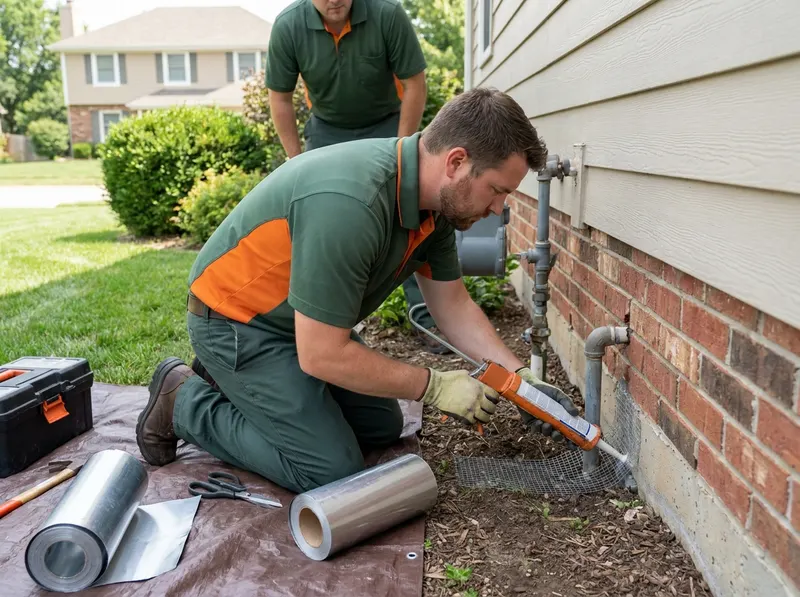
Commercial and mixed-use structures in the Crossroads Arts District and River Market experience elevated pressure due to high-density subterranean utilities and food-waste generation. For properties built upon slab foundations, such as retail parcels in the Country Club Plaza or residential bungalows in Brookside and Waldo, exclusion focuses heavily on garage door astragals, weep holes, crawlspace vents, and utility conduit penetrations. Technicians mechanically fasten corrosion-resistant 19-gauge or 16-gauge galvanized wire hardware cloth across crawlspace vents and chimney caps, while packing utility entries with industrial copper mesh and anchoring them with elastomeric, polyurethane sealants. Standard expanding aerosol foams are omitted entirely, as rodents chew through low-density polyurethane polymers within hours.

Property owners facing active rodent activity must distinguish between temporary interior trapping and permanent exterior exclusion. Trapping eliminates existing interior vectors but leaves exterior conduits open, ensuring secondary colonies relocate into the structure within weeks. Physical exclusion requires greater initial labor and diagnostic effort, but eliminates the continuous expense of recurring chemical bait replenishment. Diagnostic assessments evaluate exterior rooflines, soffits, and foundational masonry to produce a clear architectural map of all ingress zones prior to physical sealing.

Commensal Rodent Exclusion cost in Kansas

Baseline Diagnostic Assessment & Single-Point Utility Seal$250 - $400
Standard Residential Crawlspace & Foundation Exclusion (Brookside / Waldo)$450 - $1,100
Historic Multi-Story Stone Foundation Reinforcement (Hyde Park / Pendleton Heights)$850 - $2,400
Commercial Ingress Sealing & Loading Dock Retrofit (River Market / Crossroads)$1,200 - $3,800

Every job gets a firm, written price after a free on-site visit.

Common questions

How does commensal rodent exclusion in Kansas differ from standard retail extermination?
Commensal rodent exclusion in Kansas replaces temporary chemical baits and retail poisons with permanent architectural modifications, utilizing 16-gauge hardware cloth, metal flashing, and masonry sealants to physically stop entry rather than simply killing individual pests after they enter.
What structural areas receive primary reinforcement during exclusion work in Kansas homes?
Technicians reinforce baseline foundation gaps, crawlspace screening, air conditioning line-set penetrations, garage threshold seals, roofline intersections, and historic rubble stone mortar joints commonly found throughout Jackson County.
Are the exclusion materials safe for households with young children and indoor pets?
Exclusion protocols utilize inert physical barriers such as galvanized steel, copper mesh, and curing polyurethane sealants, creating zero chemical off-gassing, non-target toxicity, or secondary poisoning risks for domestic animals.
Does commensal rodent exclusion require an ongoing monthly subscription contract?
Structural exclusion is delivered as a standalone, definitive mechanical installation backed by physical barriers, requiring no mandatory ongoing monthly subscription agreements.
What factors cause exclusion pricing to adjust beyond the $250 minimum charge in Kansas?
Costs scale according to total building perimeter footage, elevation heights requiring multi-story ladder staging, the severity of historic masonry decay, and the replacement of damaged crawlspace vent doors.
Helpful resources

Trusted references & local links

USA.gov, government & consumer helpBetter Business BureauFTC Consumer AdviceU.S. Small Business AdministrationReady.govU.S. EPAENERGY STARU.S. Dept. of EnergyConsumer.govU.S. Census BureauGoogle Maps, Kansas, MO

Get started today

Tell us about your commensal rodent exclusion job in Kansas and we'll send a clear, written quote, usually the same day.

Get your free pest control services quote, Kansas

We only use your ZIP to check availability, no spam.