Flea and tick environmental control delivers exterior lifecycle interruption targeting uncultivated ground cover, leaf litter, and shaded turf perimeters. In mature Jackson County residential pockets such as Brookside,…
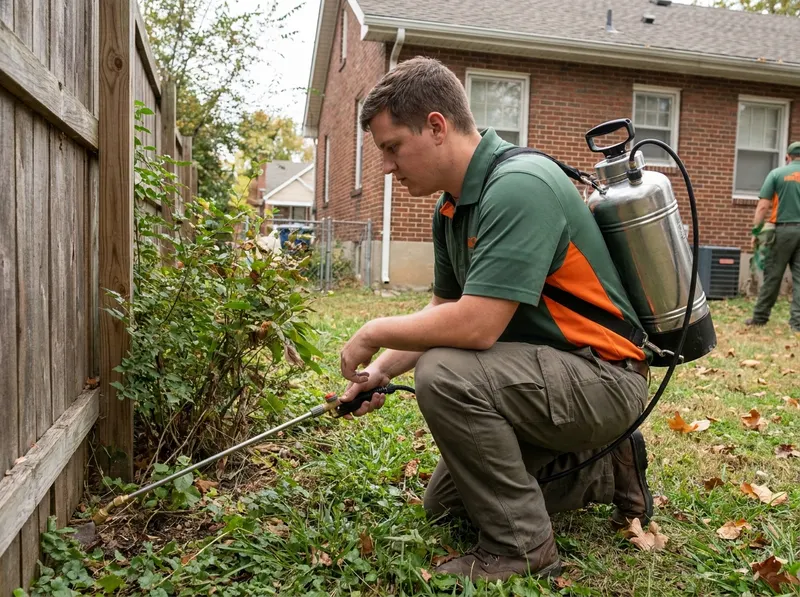
Flea and tick environmental control delivers exterior lifecycle interruption targeting uncultivated ground cover, leaf litter, and shaded turf perimeters. In mature Jackson County residential pockets such as Brookside, Waldo, and Hyde Park, substantial tree canopies produce high-humidity microclimates that sustain flea pupae and host Amblyomma americanum (lone star ticks). Over-the-counter permethrin sprays routinely fail because standard topical treatments address only biting adults, representing less than 5% of the total population biomass. The remaining 95% resides within the organic soil layer as eggs, larvae, and desiccation-resistant pupae. Entomological environmental management integrates synthetic pyrethroids with juvenile hormone mimics (pyriproxyfen) to halt chitin formation, preventing juvenile instars from completing metamorphosis.
Property layout directly dictates treatment mechanics. Properties with dense ornamental shrubbery or proximity to naturalized ravines, common in Coleman Highlands and Pendleton Heights, require deep-foliage misting up to a 3-foot vertical height where questing ticks congregate, alongside granular boundary barriers. Conversely, compact residential lots and loft courtyards in the Crossroads Arts District, River Market, and Country Club Plaza require precision micro-encapsulated foundation sprays and crawl space transitions rather than wide broadcast spraying. The primary operational trade-off rests between high-volume broadcast application and micro-barrier targeting: broadcast liquid applications immediately extinguish high-density populations across large lawns but demand strict 2-hour pet exclusion periods until dry; targeted granular treatments provide slow-release longevity within mulch beds without drift risks to urban patio spaces.
Standard protocol execution proceeds through three distinct phases. First, a diagnostic perimeter scan measures thatch depth, shaded moisture retention, and domestic wildlife corridors. Second, a combined adulticide and insect growth regulator spray covers turf transitions, shaded fence lines, and low-hanging tree branches up to 36 inches. Third, residual granular barriers are placed across foundation margins and under deck elevations to prevent migration from wildlife reservoirs such as urban raccoons and feral cats. This service operates on an as-needed basis; continuous subscription contracts are not required to obtain eradication.
Every job gets a firm, written price after a free on-site visit.
Tell us about your flea and tick environmental control job in Kansas and we'll send a clear, written quote, usually the same day.
 Viresta Insect Experts